




Q & As
UPDATED: March 2026
Northport receives many questions from different media on a regular basis, covering a wide range of issues.
In an effort to ensure accuracy and consistency of reporting we publish here the questions we receive most frequently, along with the answers.
For media enquiries please contact:
Peter Heath
Due North Public Relations
E: peter@duenorthpr.co.nz
P: 021 456 089
Expansion/Vision for Growth
- How many extra jobs, without the shipyard and floating dry-dock?
- To what extent does the expansion rely on container trade? Is it worth doing for break-bulk only?
- When will expansion happen? What will be the decision-point for the Board - in terms of both timing and commercial activity?
- What will be the impact of 24hr operations on neighbouring residential areas?
At this stage we envisage that the consented port expansion/container terminal will initially require 50-100 additional jobs at Northport. As the business case allows, the terminal will become semi-automated and then fully automated. Total job numbers will be 30-50 at that time.
The plan for expansion is based on a container trade supporting the Northland and north Auckland freight growth/demand.
As in all Northport expansion plans a solid business case will be required. This can be dependent on both the commercial demand as well as picking the right time to make the investment.
The port already operates 24/7. There are existing noise management procedures that are reviewed regularly. The consents issuedfor the planned expansion include conditions imposed around night-time operations.
Ship Yard and Dry Dock
- What does Northport have that Picton doesn’t?
- Is the shipyard and dry-dock an essential component of your growth plans?
Northport has not been contracted to consider one port facility over the other, we were asked to consider whether Northport could accommodate a floating dry dock within its future port plans. In doing so we have identified that a floating drydock and associated shipyard facilities need access to significant land based infrastructure, the floating drydock needs access as well as substantial securing infrastructure – these units cannot operate anchored out in the stream; as can be seen from our Vision for Growth plans the proposed infrastructure has sufficient area to support the planned operations. Northland has access to suitable labour and required shipbuilding trades, as well as being able to accommodate any of the shipyard staff moving from Auckland to Northland.
This is not a Northport Group Ltd project. It is being progressed by the Ministry of Business, Innovation and Employment (MBIE). Please refer all questions to MBIE.
Rail
- Do you think the spur will ever happen?
- Is KiwiRail coming to the party, commercially, with competitive rates that will make rail a viable option for cargo heading south?
- Is an Auckland/Northport rail freight service commercially viable right now? If not, what would it take to make it so?
- At what stage, and at what level of detail, are your planning discussions with KiwiRail?
- Where will the rail line go; where will the terminal be situated?
- What do you think about Wayne Brown’s point that rail should run straight to the side of ships?
The rail spur and the port expansion are complementary and both are important to Northport’s ability to play a meaningful role in a resilient and geographically-astute upper North Island supply chain. KiwiRail are in the process of purchasing the last few pieces of land within the designation while confirming the build design. Once this has been completed the actual build is estimated at five years from inception to completion.
Northport is not privy to the commercial rates provided by KiwiRail.
Increased freight volume and either a reduced road-bridge cost or a small container siding at Oakleigh (being discussed with KiwiRail).
Northport meets regularly with KiwiRail, as this project ramps up there are plans for in depth discussions around rail requirements at Marsden Point.
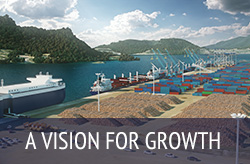
Check out the video on our ‘Vision for Growth’ website , or the slider on this page.
This type of rail configuration is no longer adopted by modern port design; the turnaround
times/productivity of ship loading/discharge makes direct to hook delivery impractical, operations need all
of the cargo at the port and stacked for multi-port/destination loading before ship arrival.
For discharge the cargo needs to be removed from under hook as soon as landed and taken to storage areas for
sorting/stacking for specific destination(s).
Cars
- What’s your position on cars? You spoke some time ago about an alternative business model for the vehicle import trade; what progress?
- You have a job to do, to win over the sceptics in the motor trade. How do you plan to do that?
We continue to work closely with potential customers that see the opportunity to move out of Auckland and are available to mitigate the challenges facing the industry with the capabilities and space we have here. Northport has continued to discuss an alternative to the current car-import model at Ports of Auckland. We are not suggesting a like-for-like operation but an ‘out of the box’ approach whereby cars are imported into Northport and delivered to an adjacent car storage/preparation facility. Then either collected by the customer directly or delivered door-to-door.
Selling the concept relies on ongoing and effective communication with industry players, while working closely with potential customers that see the opportunity to move out of Auckland.
Cruises
- Do you intend to build cruise-specific facilities to become a cruise terminal?
There is no reason for Northport to build a purpose-built cruise facility. The cruise industry is happy to berth alongside a commercial wharf facility, especially if that avoids an anchoring situation and disembarking/embarking by tender.
Log fumigation
- Where can I find more information?
Please see extensive background and additional information here.
Discussion over the future of Ports of Auckland
- Is Northport still lobbying for a share of Auckland’s cargo? If so, how?
- Do you disagree with the notion that the Port of Auckland should be shut down and its operations moved elsewhere in their entirety?
- You call for a resilient, geographically astute, three-port supply-chain strategy for the Upper North Island. What does ‘geographically astute’ mean?
- How realistic is it to expect imports to be directed to the Upper North Island port closest to their intended destination? Is that even possible?
- What trends in international shipping are addressed by a three-port supply-chain strategy for the Upper North Island?
- What now needs to be done before an informed decision can be made about a future UNI ports strategy?
- Some industry figures are calling for a study that looks at freight demand over the next 30 years to ensure we have the right capacity, and in the right places. This would include freight modelling - where is export/import demand going to grow? Do you agree?
- Should ports be working more collaboratively and, if so, what needs to happen to make this possible?
- Why has Northport kept such a low profile in the national conversation about moving Ports of Auckland?
Northport has not, and does not, lobby for a share of Auckland’s cargo. Freight will only relocate if the business case stacks up and the customer sees value in the relocation.
Northport supports the wider view of the three Upper North Island ports working collaboratively to better utilise their current and potential footprints to support the Upper North Island’s current and future freight demand. Innovative technology provides for better optimisation of port cargo storage/transit facilities and automation can increase productivity resulting in smoother ship turnaround.
Identification of where the Upper North Island population will grow/relocate and in turn identifying the freight location and/or destination within the area enabling sound decision making with regard to infrastructure requirements; i.e. geographically astute rather than parochial decision making.
High value freight will take advantage of earliest/fastest routes as the product can afford to travel/be multi handled, where the lower value freight will focus on total end-to-end cost. While more focus can be placed on receiving freight at the closest port in reality it will depend on shipping services and frequency.
Reducing the number of international port calls to reduce overall supply chain costs. However, for this to work effectively there is a need for multi-modal efficient supply chains: road, rail, and coastal shipping.
There are two options, allow commercial decision making to drive the outcomes, or undertake a countrywide freight demand study with a focus on the UNI – this will require future population and industry projections and their associated freight growth demand.
Yes – as per above.
New Zealand ports need to work more collaboratively. However ports have to be wary of the difference between ‘working collaboratively’ and ‘collusion’; in our view, relatively recent changes in leadership at ports around the country have created new opportunities to better discuss opportunities within the supply chain.
This has predominantly been a political arena; Northport has remained apolitical throughout and provided through its Vision for Growth factual information about its capability.